Friday, 14 December 2012

Critical Reflection - Year 2, Semester 1


Critical Reflection

It would be fair to say that, as an editorial product, WINOL is the most popular student-lead news organisation in the UK, which is proven in the comparison of our Alexa ranking to that of others. This is particularly impressive for such a small group; with only around 30 students in an area that is not particularly heavy with news, maintaining the high standard of each 10-15 minute bulletin as well as the website and features sections is certainly a challenge.

In terms of our popularity, our website’s global traffic has more than doubled in the last 10 weeks and we have been consistently the top online student editorial site in the UK for the last month according to figures on the Alexa website. In the last two weeks we have been tracking and comparing the ranks of several major student-run news sites. As of today, 9th December 2012, we are ranked #476,793 globally and #10,338 within the UK, according to Alexa, whilst our closest rival, East London Lines, are at #593,839 and #23,814 respectively. Whilst the difference may be fairly slight in terms of rank, the resources available to our competitor far outweigh our own; the students working on the publication are all masters’ degree students, so therefore have a greater knowledge of their medium as they should have already had experience in the field. They also work in London which is a much more news-rich area of the country. However, I personally feel that their content is not as well written as our own; their stories often seem to be reminiscent of a press release in their tome, which is likely to be the source that they have come from. There is, though, one aspect that they do seem to be beating us on, which is their still pictures. However, the quality of our photos are steadily improving, which may form part of the explanation as to why we have now overtaken them in terms of global rank. Similarly, our reach is also greater than that of our closest competitor on a local level, The Hampshire Chronicle; their global rank is #894,774 and in the UK they are ranked #43,856, showing that we are almost twice as popular worldwide and over four times more popular within the UK which, in my mind at least, proves that the quality of our content is just as good, if not better, than that of professional news organisations. Overall, our reach in the last month has improved by 70% and 160% over the last 3 months.

Aside from the quality and frequency of our uploads, there were several other aspects of our site that seem to have influenced the upward trend in our viewings. Possibly one of the bigger aspects is the much improved features section that makes our site what many would call ‘sticky,’ meaning that people spend much more time on the site after finding an interesting feature than they had initially intended whilst checking on the latest news. The way in which features have been structured both on the site and within the news room has increased its success in that their improved organisation allows for greater quantity and quality of each article. Another factor is the use of live shows to cover both local and global significance on the site, such as the American election and the Hampshire Police and Crime Commissioner debate.

One other new innovation that is likely to be responsible, at least in part, for the increased circulation is the new and improved use of social media. As WINOL’s social media editor, I have been in charge of increasing our followers on twitter, creating and maintaining a Facebook page and driving social media users towards our websites, amongst other things, which has helped to maintain and expand our news operation’s internet presence. As social media has become such an important part of the internet in the modern era, the role of social media editor has become a vital role within any news organization; twitter in particular has an important role both in alerting people to the presence of new articles and to advertise the article through ‘retweets’ where other people share your 140 character post with other people. In the first week, we began with around 650 followers which has increased to over 1000 in the 10 weeks WINOL has been active this semester. This impressive increase in numbers has been largely responsible due to the frequency of tweets and Facebook updates as well as through the use of a consistent and easily read style, including links in each direct to winol.co.uk.

Another part of my role is to ensure that my colleagues maintain some form of twitter presence; by promoting their own work for WINOL and retweeting things from our social media we can dramatically increase the number of people our messages reach. This, combined with messages that target specific people such as interviewees and interested parties, allows us to portray our articles and their importance directly to those with a specific interest in a story as well as our regular audience. Whilst it is not necessarily the most efficient way of contacting relevant twitter users, a large part of my time each week has been devoted to searching twitter user names of groups and individuals who may have an interest in our stories. To improve on this in the next year, however, it would make more sense to get the journalists working on each story to compile a list of relevant twitter user, or at least groups likely to have a twitter account, as this would make it a much quicker process. It would also be easier as the person who wrote the story understands who would be interested in it much better than anyone else would. It is also vital that they use their own professional twitter account more frequently and effectively and ensure that it is kept separate from their personal one. It would be much easier to increase our followers further through this; by discussing where they are going, who they are interviewing and interesting still photos of people and places relevant to their work they keep up our appearance on the internet and spark interest from followers in their work. Through this, we can gain further followers and views, especially if the tweet links to the site on a relatively regular basis.

Where using twitter becomes difficult is getting people outside of your followers to see your tweet. The normal way of doing this, other than getting retweets, is to use hashtags. However, many of the ones that are popular and are “trending” are not appropriate for us, as a news site, to use. TO try and counteract this, we have started our own hashtag “#WINdeals” which is a way of people finding deals in the local area. However, this has had very limited success as local, relevant deals are difficult and time consuming to find. There has become a definite lean towards the Students Union in these tweets as well which is a problem as we are supposed to be impartial and therefore should not appear to be affiliated with any aspect of the University.

As well as the use twitter, I have created a Facebook page for WINOL which may not be as popular as our twitter site but has still been fairly successful in its brief existence thus far. Comparatively, it has gained more followers than that of rival student news groups that have had their Facebook page for around the same length of time. I have also created a mailing list for students and faculty within the University, which may not necessarily be particularly useful in terms of circulation but has been quite helpful as a method of presenting and reminding people of our presence in terms of giving us interviews and story ideas. For example, I received a reply from one of the sports lecturers about having rugby coach Eddie Jones in as a guest speaker and passed on this information to those working on Sportsweek who interviewed him.

On top of my work as social media editor, I have been involved in a variety of WINOL run events, often being in charge of live tweeting the event, including (but not limited to) the HPCC debate, the American Election special and the BJTC Awards 2012. I have also aided many of my colleagues in filming and attempted to create a Christmas themed consumer review of the top toys for the year. After compiling a large number of lists, I was unable to find a supplier willing to give me the toys to review despite saying that they would be donated to either a charity or school afterwards. As I intend on attempting this again next year, I will begin research earlier as well as start phoning toy companies sooner and more frequently.

Overall, I feel that WINOL has been very successful this semester and that my role within it has certainly been a fairly vital stepping stone in our road to this. Of course, WINOL has some flaws that still need to be ironed out – the website breaks fairly frequently and is still not overly user friendly (though it is vastly better than it was before) and the turnover time for features between filming and upload can still be unnecessarily long – but it has certainly improved which is reflected in its overall popularity and rank.

Sunday, 2 December 2012

Teleology:

Teleological thought. (c) Hannah Hayesmore

Teleology is the idea that everyhing has a purpose or end to it; in terms of philosophy this generally refers to the concept that history is moving toawrds an end purpose, whether it be a place of peace and happiness or one of misery.

Karl Marx believed that the world was moving towards an ideal world, a state similar to Nirvana, in which the world is equal due to communism. Through history (and what we learn at each stage), Marx suggests that we will eventually change the current state of political and social form (for more on Marxism, see: http://hazny182.blogspot.co.uk/2012/02/hcj-karl-marx-and-communist-manifesto.html). Freud believes that Marx is too optimistic in his belief in teleology but agrees with his idea that alienation causes misery in society.

It could also be suggested that Darwin believes in a form of teleology as evolution is the alteration of design in animals towards a sort of ideal animal. Plato's teachings could also be considered teleological as he suggests that the world is aiming for (and moving towards) the ideal forms.

Wednesday, 28 November 2012

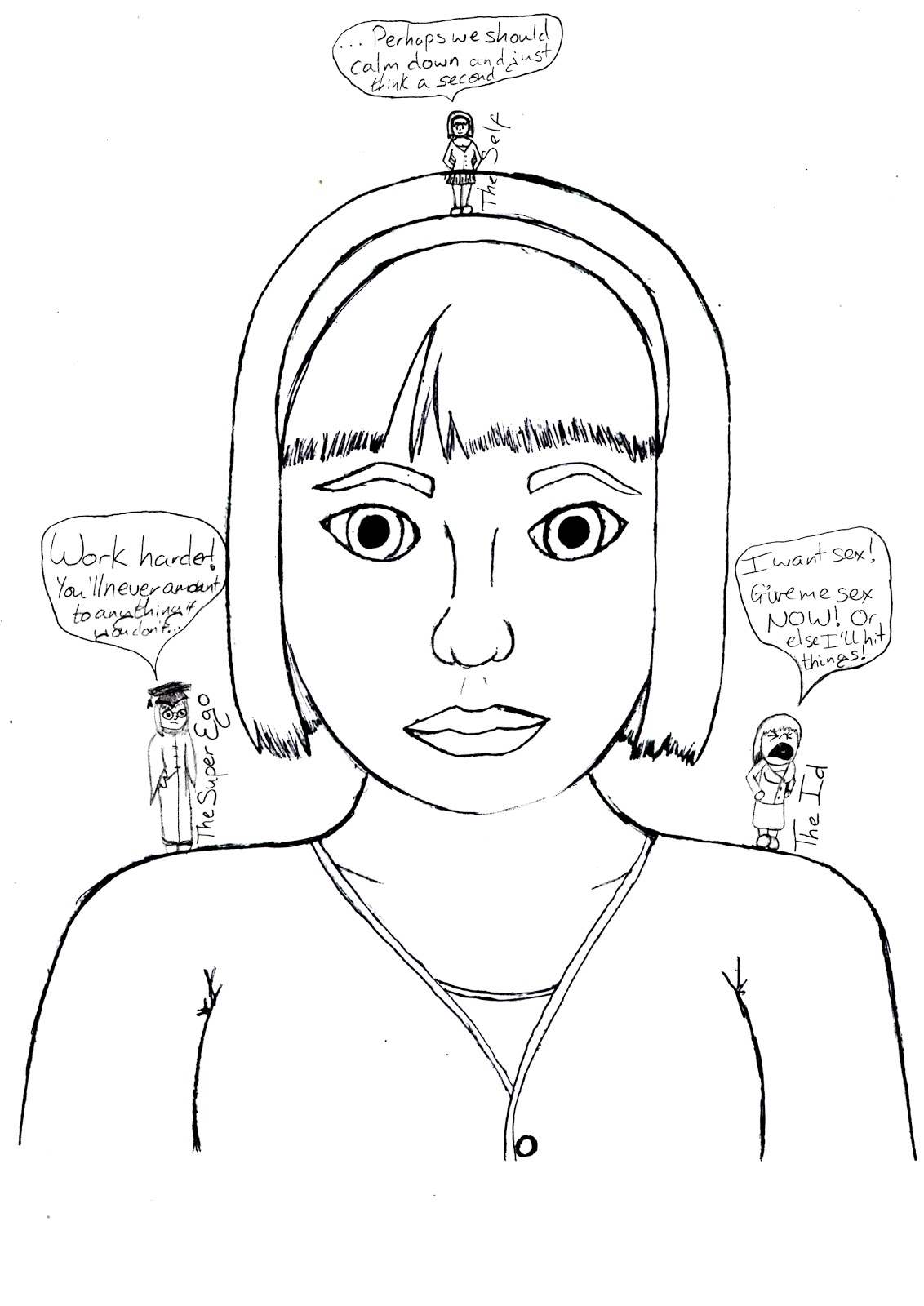
Freud and the mind:

The mind, according to Freud. (c) Hannah Hayesmore
According to Sigmund Freud (1856-1939), the reality of human nature is pain due to the devision between the three different parts of ourselves. These three parts are:
1) The Id is part of us from birth and is derrived from the animal side of us. It is our instinct to gain pleasure and avoid pain, responsible for aggressive and sexual nature. The Id is our dominant personality.
2) The Self (or Ego) is the voice of reason that we develope personally. We think this is dominant but is actually tthe weakest part of us. It keeps us grounded in reality and voices moderation and common sense.
3) The Super-ego is our internalised rules given to us by our parents and society. It develops after birth through socialisation. It punishes us with guilt when we do not meet its often unrealistic demands.
Each of these parts of our conciousness contradict one another, which leads to misery.

Tuesday, 27 November 2012

Channel 5 News Critique 27/11/12 (5pm)

As our guest editor this week is Geoff Hill, the WINOL team has been asked to review the Channel 5 news. It is a 20 minute bulletin, with an opening sequence that cuts straight to the headlines after it is introduced at the end of the adverts. The headlines are quite pacey and generally cut the point. Today’s headlines were:

·         Flooding across Britain;

·         Bill Tarmey funeral; and

·         BBC Sports personality of the year 2012 contenders.

The fact that there is new angle on the first story as it could become a little repetitive without it and he shots of the floods from the helicopters were fairly visually interesting. I felt, however, that the Bill Tarmey story was perhaps not important as others that could have taken its place in the headlines. I also thought that the edit on Chris Hoy for the sports personality story looked a little strange; I realise was to tease the audience, but I feel there were probably better ways of doing this by perhaps choosing a different clip or using a different edit.

For the first live cut to the floods, I thought the positioning with the fire engine in the background looked good. The way in which the UK map moved as locations were pinned on there looked odd as the pins did not move with it and the interview with David Cameron seemed quite bland; the statement made seemed very pre-prepared and perhaps a better quote was available, perhaps different questioning could have acquired it. The second throw was very same-y in a way and some of the quotes and questioning of the rescue person and those in hostels seemed a little weak and pointless. It wasn’t overly interesting either. The interview with the man trapped in his house was very good though. Personally, I found it impressive that the sound was so good in that interview when there was no way of getting him a good mic.

The Norovirus story had too many facts from the interviewees and the dramatic music at the end sounded very out of place in the VT. The story about the rebate was seemed very important yet was over so quickly I didn’t get a chance to make many notes on it.

The Nadine Dorries story didn’t seem to be as important as fourth story to me, especially as there was not a lot of new information.

The “still to come” before the ad break seemed much better in its construction than the headlines. However, the news recap after only included one story, which I felt made it a little short over all.

The possible murder of President Yasser Arafat was a very interesting story, however it wasn’t particularly grabbing visually and the interviews did not add a lot, especially the scientist who mostly spoke about facts.

Bill Tarmey funeral, whilst quite moving, seemed unusually long. It would, perhaps, make more sense to be that long if Coronation Street was a Channel 5 program. There was also a strange buzzing during part of the eulogy which could have been removed or at least faded during edited.

The crane fire story was very visually interesting, using good images for a good length. The story was about the right length to, however the scripting could have been more dramatic and had a greater focus on the people involved.

Chris Hoy was quite oddly framed in the Sports Personality story. It became a little better when it was tightened but seeing the back of the journalist’s head was a little jarring and unnecessary. The voiceover quality was poor and seemed to peak quite a lot. Personally, I would have cut (or at least shortened) the last voxpop as it was a little long, as was the overall length of time dedicated to them.

Overall, I found the bulletin quite informative and enjoyable. However, finding things I could critique gave me confidence for our own on http://winol.co.uk (live at 5pm every Wednesday, in case you don’t know) and for my own future career, as well as those of my colleagues/fellow students.

Tuesday, 20 November 2012

Website Designs


Over the course of the year, the WINOL website (www.winol.co.uk) has taken on a variety of faces as we try to modernise and build a more user-friendly site. However, there is certainly still room for improvement which is why, over the last few weeks, I have been creating some new designs and feel I’ve finally come up with something worth publishing. The design attempts to draw on features of   both other news websites as well as mobile applications which are becoming more and more popular ways of finding out the news.
Starting by introducing a colour scheme and taking elements from our original site, I created a front page that incorporates all the various aspects of the site, from news to sport and from radio to features.
The idea is to have a bar at the top that scrolls with you to make it easy to navigate from one page to the next. It includes a drop down menu with all the various sections of both news and features on it.
News:


In pictures:
As with many news sites, I have decided it would be good to include an “In Pictures” section that would combine the news in brief with pictures from the events. This would mean, though, that our reports are likely to need camera training and will have to remember to take pictures for each story, something that I have been encouraging them to do already as photographing things as you work looks particularly good on our social media profiles, particularly twitter.


Features:


Radio:
Starting this morning, WINOL has taken over a regular slot on Sound Radio - the University of Winchester’s student radio station – every Tuesday from 10am to 2pm. We have decided to record each show and create a pod cast of the best bits using Sound Cloud. Therefore, it is important that we have a radio page both with the podcasts and, ideally, a live payer for the site (or, failing this, a link to www.sound-radio.co.uk)
Sport:


Friday, 16 November 2012

Review – The County Arms (Winchester)


As one of the closest pubs to the University of Winchester, The County Arms is a fairly popular student haunt. It is also near to the hospital and police station, so it is also visited by many local people, particularly during sporting events as it has several television screens. Alongside an array of drinks, the pub also serves food.

Emma and I visited The County Arms on the 15th November. Upon entering, we found the pub to be quite quiet and were easily able to find a seat. We found the menu had a large variety of dishes to choose from, which made it hard for Emma to decide what she wanted. After much deliberation, Emma went to the bar to order. She found the staff friendly and, even once business had picked up, they never seemed too busy to help.

Whilst our selection arrived relatively quickly, both Emma and I found that the food quickly lost its temperature. Having ordered the tuna and cheese melt baguette with a side of sweet potato fries, I had anticipated a much warmer and more toasted offering. The baguette seemed undercooked and was quite pale in its complexion while the sandwich filling had almost no warmth to it at all. I also found the ratio of tuna to cheese to be overly weighted towards the fish, almost as though the cheese was an afterthought. The sweet potato fries seemed to be unseasoned however, they were well cooked and beautifully crispy. The salad garnish was lackluster at best; the lettuce was limp and the dressing looked unappetisingly grey. I found their selection of wine to be far too weighted towards the drier end of the spectrum. Whilst I am no wine expert, I do know that I much prefer a sweeter bottle so my choice was immediately narrowed. I ended up opting for a glass of the sweetest (and also newest) white on the menu, Yellow Tail Moscato, which was slightly sweet and lightly fizzy with a fruity finish to it.

Emma’s meal, pasta meatball marinara, also got cold fairly quickly. She said that she was “less than impressed” with her meal, though still found it pleasant. Describing it as tasting “homemade,” she was a little disappointed that, whilst the food was nice, it was no better than something she could easily make herself any night. The pasta was a little soggy and the meatballs grisly.  She also said she would have liked more olives in the sauce as this is how it was advertised and, at first, thought that there weren’t any in there. Emma found the garlic bread, too, was soggy; she wanted something crunchy “almost like bruschetta” but thought that the fact it was ciabatta bread that was used was “a nice touch.” As a bit of a cola connoisseur, she rated their soda 5 on a scale of 1-10 (10 being perfect and 1 being ‘I had to take it back to the bar’) as the syrup content was quite low and the ice melted in it making it watery.

Personally, I found the décor fairly pleasing if only as it seemed almost familiar; it has a fairly standard English pub look to it, though some of the colours seemed a little ‘mishmashed’.

Overall ratings:
Haz: 
Emma:

Sunday, 4 November 2012

HCJ3 Economics Seminar Paper


HCJ3 Week 6 - Seminar Paper - Economics

Economics


Adam Smith (1723 – 1790) published “The Wealth of Nations” in 1776; it asked and discussed why some countries are richer than others. His ideas can be summarised by saying that richer countries have 3 characteristics:

1.       Liberty – people are free to go and do as they please (within the law) and can calculate the risks and benefits of transactions they make.

2.       Free trade – people are not forced to produce certain things by the government but are free to produce what they wish.

3.       The ‘hidden hand of the market’ – people pursue their own self-interest to maximise utility (see Utilitarianism). This is beneficial through the law of unintended consequences (where our actions have impacts that we had not intended or considered).

However, Smith’s theory was widely criticised as it lead to the alienation of people through labour division. He also suggested that unemployment was only ever temporary; this became very unpopular during the depression in the 1920s and 30s.

David Ricardo (1772 – 1823) accepts most of Adam Smiths’ works. However, he differs to Smith in his idea of value. Smith suggests that there are two types of value: use and exchange. Whilst something may be useful, it is not necessarily got a high exchange value as it may be quite plentiful. Ricardo suggests that this is wrong; things like water (high use, low exchange) have a low price as very little labour is needed to produce it. He says that natural objects have no real value until humans interact with it and force value upon it; this is called labour power. He also says that, whilst supply and demand will have a factor on the price in the short term, the overall price for something tracks the amount of labour that goes into it.

Thomas Malthus (1766-1834) believe that population needed limiting as eventually it outstretched the supply of food, housing and jobs.

In his theory:

Population increase > ‘bad times’ > economic expansion > ‘good times’ > population increase > ‘bad times’ > etc.

This cycle drives the economy and other developments (such as in technology) forward. For this reason, Malthus was against the poor laws and for the Corn Laws as these interferences would prevent the cycle continuing properly.

However, history did not continue in the way he had predicted. His ideas failed to take into consideration that each extra person was an extra labourer to produce food, housing, and so on. Neither had he thought that the productivity could increase so dramatically with the use of new technology.

Karl Marx (1818 – 1883) theorised that Capitalism is unsustainable due to the ‘iron law of wages’; due to the need to create profits, the wages of labourers are insufficient to purchase the items they create. He says that capitalism exploits the working class through the surplus theory. The theory suggests that if a labourer earns the wages he needs to sustain himself each week by working 20 hours but is contracted to work 60, the other 40 are surplus labour and he money for working them is surplus value, which is how profit is created. The money the worker would earn in this time, essentially, goes to the employer. Instead of earning £15/hour for 20 hours work, labourers earn £5/hour for 60 hours work and the extra money becomes profit. The flaw in this, of course, is that Marx assumes that, no matter how much profit a company is making, it will only pay its workers enough to live off of. However, this is not the case of employers in developed countries which should have been the most affected and led the revolution. He also hadn’t considered the ‘credit’ system, where you can borrow money and repay it over time from banks.

In classical economics (like Adam Smith’s), money is said to have no effect on people’s actions and works merely as a scoring system. However, modern economic views suggest there is a “money effect” where the use of currency changes people’s behaviour.

John Maynard Keynes (1883 – 1946) says that saving money reduces the money in the economy, so your income also goes down. In a simplified version of this:

There are two people in the world, person A makes £100 a week by selling widgets to person B at £1 a widget and person B makes £100 a week by selling thingies to person A at £1 a thingy. The total income in this economy is £200, which corresponds to 100 widgets and 100 thingies.

If person B decides to save £50 out of his £100 and keep it in cash. As a result, person A’s income falls to £50 and the total income in the economy is now £150 - with the economy producing 50 thingies fewer than before. In the following week, person A only has £50 to spend which means that person B's income also falls to £50 and they end up buying fewer widgets.

Critics of this point out that this system would allow legislators to interfere with the ‘private sector’ & potentially affect the free market. He also doesn’t consider the complexities of modern banking, where savings are invested to try to create more money and help the economy.

Utilitarianism


Jeremy Bentham (1748 – 1832) was influenced by Hobbes’s negative outlook on human nature; his utilitarian outlook in “An Introduction to the Principles of Morals and Legislation” (1789) says the mankind is governed by pain and pleasure. He suggests that legislation needs to be able the gauge the value of pleasure and pain; it is the business of the government to promote the happiness of society by rewarding & punishing accordingly. As punishment is such an evil, in his opinion, it should only be used it if promises to exclude a greater evil. It should also work as a deterrent and should not be harsher than is necessary to deter the offender, the public or both from acting in such a manor in future.

He was less concerned with the morality of each individual and more interested in offering guidance to leaders and legislators on managing communities. He suggests that:

A: 

Is better than

B:

As, overall, you score more ‘happiness points’. Of course, this is dependent on if you focus on “most people” or “most happy”, therefore legislation needs to be supplemented by some sort of limit on the amount of inequality & degree of misery for the worst off.

John Stuart Mill (1806 – 1873) was a student of Bentham as a child. As such, many of his ideas are very similar to Bentham’s. However, he tries to improve them by ranking happiness rather than assuming all pleasures are of an equal value. He also emphasises the importance of setting limits to the constraints systems could put on individuals and their independence, though does not offer many ideas as to how to fix restrictive legislation.

In his book “Principles of Political Economy” (1848) he states that everyone should be taxed equally as progressive taxation penalises the hard working and those who save more of their money. He also says that we should have an almost entirely free market with the price being dependent on supply and demand rather than any government regulation. He made exceptions, however, on things like alcohol on utilitarian grounds. Later, his views began to bend more towards socialism: he suggested abolishing the wage system for a co-operative one.

Mill promoted economic democracy; in a capitalist economy, workers should be able to elect their managers. He also thought that population control was essential in the working class to improve their conditions and ease the competition for jobs as more competition means lower wages.

Currency and Inflation


Currency is a “unit of purchasing power” or a medium for exchange. It is, essentially, an I.O.U. for more stuff. Originally, it was backed by a “gold standard” where each sum of money was worth a certain amount of gold and could be exchanged in a bank; this is no longer the case.

Inflation is when currency becomes less valuable over time due to 2 factors:

·         People’s perception of money

·         Supply and demand (which has the bigger impact)

Printing more money increases inflation: doubling the number of notes in circulation halves their worth. This is bad for people on a fixed income, such as pensioners. For people who earn a wage, however, this has less of an impact as their wages increase at the same rate.